Security patrol vs standing guard comes down to one question: does your property need a continuous presence at a fixed point, or documented, unpredictable coverage across the whole site? A dedicated standing guard delivers the first. A mobile patrol delivers the second. Both are legitimate, they solve different problems, and choosing the wrong one either leaves a gap or spends money where it is not needed. Here is how we walk clients through it.
Quick Answer: Security patrol vs standing guard is a match between coverage and risk. A standing guard gives continuous, fixed presence for a specific point that must be controlled. A mobile patrol gives documented, randomized coverage across a whole property at lower cost. Many properties are best served by a hybrid. Americal Patrol assesses your site free before recommending a model.
What Is the Difference Between a Security Patrol and a Standing Guard?
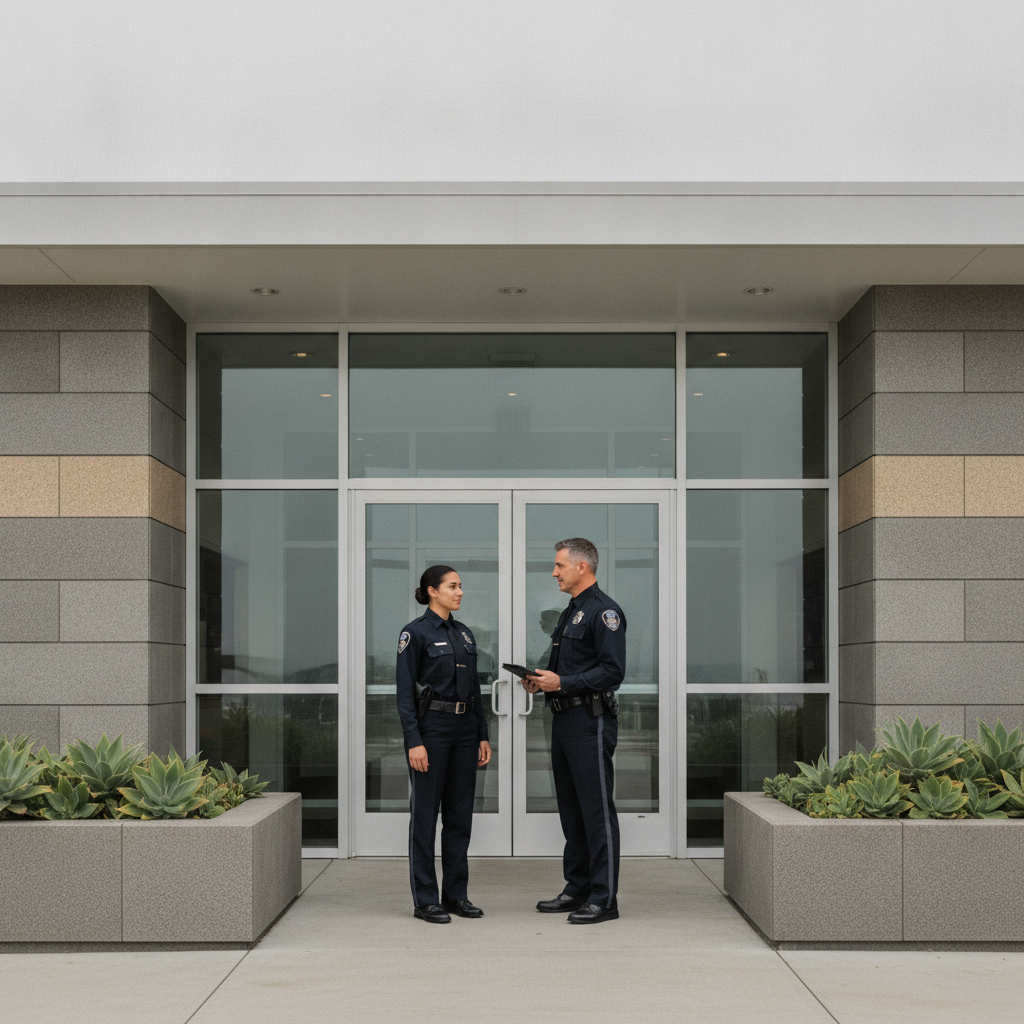
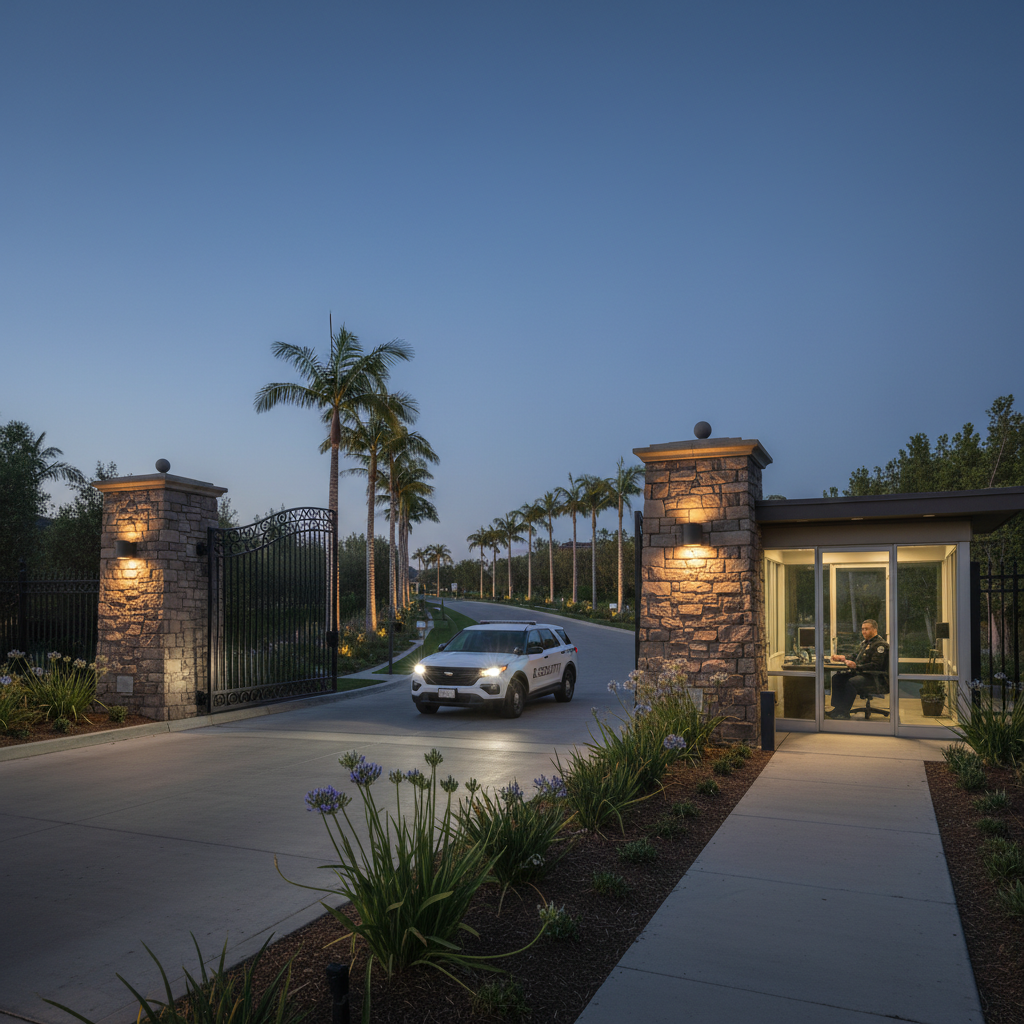
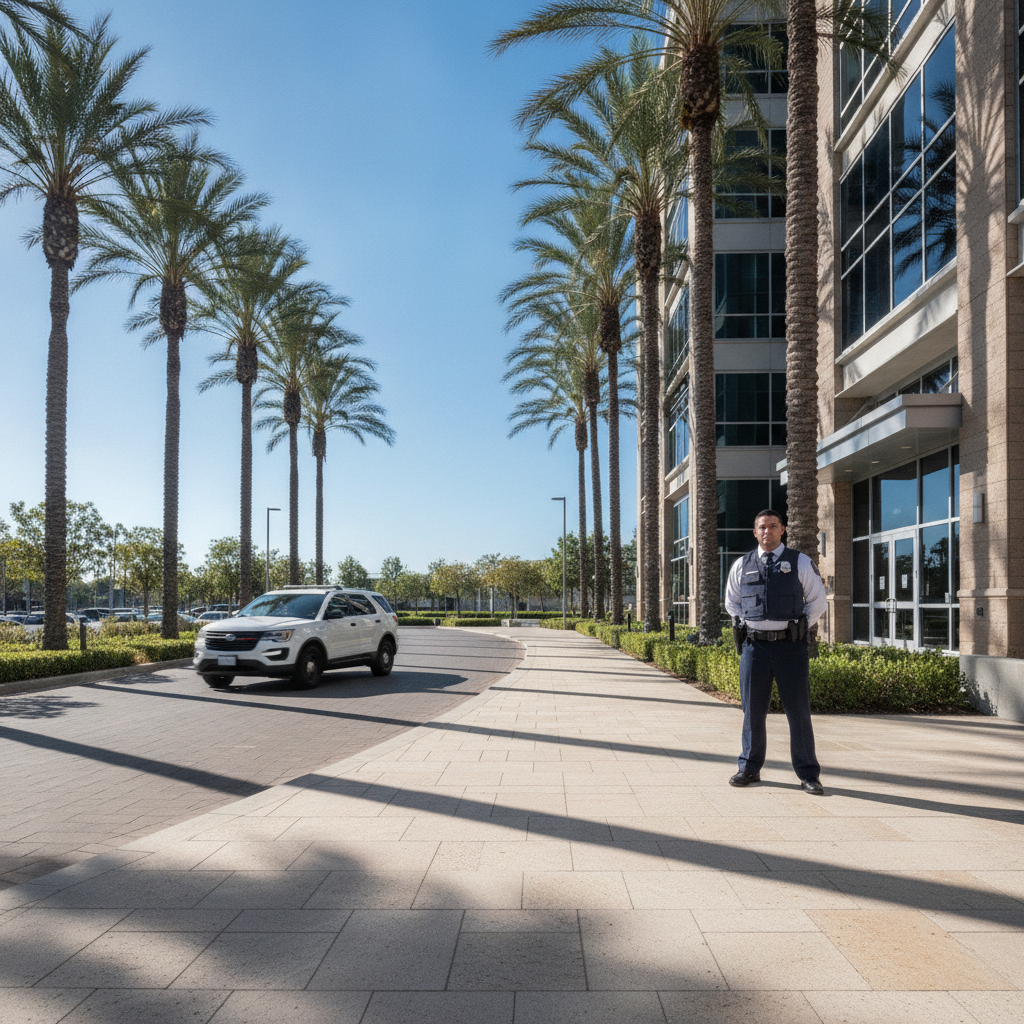
A standing guard is an officer stationed continuously at a fixed post for a defined shift, while a security patrol is an officer in a marked vehicle who covers your property on scheduled, unpredictable visits, often across several nearby sites. The standing guard holds one point without a break; the patrol delivers documented presence in intervals across a larger footprint.
A standing guard, sometimes called a dedicated or post guard, stays in one place or works a fixed area: a lobby, a gate, a construction entrance, a front desk. For the length of that shift, the property has a continuous, visible human presence. A mobile patrol officer arrives, inspects the property, checks the things your post orders specify, documents the visit, and moves on to the next stop. Coverage is periodic rather than constant, and the schedule is intentionally unpredictable so no one can time the gaps. Both models are staffed by the same licensed security guards; the difference is how their time is deployed against your risk.
Which Model Gives Better Coverage, Constant or Periodic?
Neither is universally better, because coverage should match exposure. A standing guard gives unbroken presence for the hours posted, which is the only model that works when a site needs eyes on it every minute. A mobile patrol gives presence in intervals, which is the efficient answer when risk is spread across time rather than concentrated at one point.
A standing guard means nothing happens on that property during the shift without someone there to see it, respond, and report. For a single high-value point that must be watched continuously, that is the model that delivers. A mobile patrol service leaves the property unattended between visits, but that is not a weakness when the risk is an empty office park overnight, a residential community that mainly needs after-hours enforcement, or a lot that draws occasional trespassers. The patrol shows up often enough, and unpredictably enough, to keep the property on a routine that deters the people you are worried about.
How Do the Two Models Deter Crime Differently?
A standing guard is a fixed deterrent and a mobile patrol is a moving one. Anyone approaching a posted officer sees a person who is not leaving, which is powerful at a single high-value point. A patrol vehicle arriving at odd hours signals the whole property is watched and that no one can predict when an officer will appear.
The fixed deterrent works best at a main entrance, a cash office, or a site that has already been targeted, where the message needs to be continuous and unmistakable. The moving deterrent works best across sprawling or multi-building properties, where unpredictability over the entire site beats one officer fixed at a single point who cannot be everywhere at once. This is not a niche trade-off. The National Council of Investigation and Security Services represents nearly a million professionals across the security services industry, a scale that reflects how many properties nationwide weigh exactly the patrol-versus-post decision this guide walks through. For gated communities and large residential properties, this is why our HOA security patrol accounts across communities like our Simi Valley security guards service area so often run on routine patrol rather than a single posted officer.
How Do Security Patrol and Standing Guard Compare on Cost?
A standing guard is continuous labor committed to one property, so it costs more than a patrol that shares an officer’s time across several sites. That does not make patrol the cheaper answer in every case; it makes patrol the efficient answer when a property does not need constant presence at a fixed point.
The right question is not which is cheaper, but which spends the budget where the risk actually is. Paying for a dedicated guard on a property whose real exposure is a few overnight hours wastes money. Relying on periodic patrol for a site that needs continuous control of a single entrance leaves a gap that will eventually be found. Value comes from matching the model to the exposure, not from defaulting to the lowest line item. We break the full pricing picture down in our guide to what drives the cost of security guard service.
When Does Each Model Fit Best?
A standing guard fits staffed lobbies and front desks, access control at a gate or dock, construction sites during active hours, retail during business hours, events, and any property with a specific point that must be continuously controlled or a documented history that warrants a constant presence. A mobile patrol fits properties that need documented, unpredictable coverage across a whole site rather than a fixed presence at one point.
Mobile patrol usually fits homeowners associations and gated communities, apartment complexes, office and business parks after hours, industrial yards and storage lots, and vacant or transitional properties. Standing guards suit higher-traffic control points where a break in presence is unacceptable. Active construction site security is a common case for a gate guard during working hours, and a busy commercial lobby is a classic standing-post assignment. Across our security coverage across Ventura County, gated communities and after-hours business parks are the properties that most often run on routine patrol rather than a fixed post, precisely because their risk is spread across a footprint instead of concentrated at one door.
Can You Combine a Standing Guard and Mobile Patrol?
Yes, and many properties are best served by a hybrid. A dedicated officer covers the point where risk is concentrated, and mobile patrol covers everything else, so you put continuous presence exactly where and when the risk is highest without paying for a full-time officer at every point.
In practice, a construction site might run a standing guard at the entrance during working hours and switch to overnight mobile patrol once the crews leave. A large HOA might use routine patrol across the community with a dedicated officer added at the clubhouse during weekend events. A commercial property might keep a lobby guard on weekdays and rely on patrol on weekends. The schedule follows the risk instead of a one-size template. If part of your decision is whether those officers should be armed, our guide to armed vs unarmed security guards covers that separately.
How We Decide With You
Every recommendation starts with a walkthrough. We look at what needs protecting, when the property is exposed, how people and vehicles move through it, and what has actually happened there or nearby. From that we propose a model, standing, patrol, or a hybrid, and we explain why. As the property changes, so does the plan. That judgment is what the profession is built on; industry bodies such as ASIS International, with more than 34,000 security professionals worldwide, exist to standardize how officers assess and cover risk rather than default to whichever model is easiest to staff. That local knowledge is built over decades, and you can read more about it in our post on why a 40-year security company matters when your HOA signs a 5-year contract.
Americal Patrol has provided licensed security patrol services across Southern California since 1986, and today serves commercial, industrial, and residential clients across our Thousand Oaks security guards service area and throughout Ventura, Los Angeles, and Orange Counties. If you are weighing a mobile patrol against a dedicated standing guard, or you are not sure which your property needs, call us at (805) 515-3834 for a free consultation, or request a free security assessment. We will assess the site and recommend the coverage that actually fits, not the one that is easiest to sell.
Frequently Asked Questions
What is the difference between a security patrol and a standing guard?
A standing guard is an officer posted continuously at a fixed point for a defined shift. A mobile patrol is an officer in a marked vehicle who covers your property on scheduled, unpredictable visits, often across several nearby sites. One holds a point; the other covers a footprint in intervals.
Is a mobile patrol as effective as a standing guard?
For the right property, yes. When risk is spread across a whole site rather than fixed at one point, unpredictable patrol visits deter activity across the entire property more efficiently than a single stationary officer. When one critical point needs constant control, a standing guard is the better fit.
Which is cheaper, security patrol or a standing guard?
Mobile patrol usually costs less because an officer shares time across several nearby sites, while a standing guard is continuous labor committed to one property. The cheaper option is not always the right one. The best value comes from matching the model to where your risk actually sits.
When does a property need a dedicated standing guard?
A standing guard fits staffed lobbies and front desks, gate or dock access control, active construction sites, retail during business hours, events, and any property with a specific point that must be continuously controlled or a documented incident history that warrants constant presence.
When is mobile patrol the better choice?
Mobile patrol fits homeowners associations and gated communities, apartment complexes, office and business parks after hours, industrial yards and storage lots, and vacant or transitional properties, any site that needs documented, unpredictable coverage across the whole property rather than a fixed presence at one point.
Can I combine a standing guard with mobile patrol?
Yes. A hybrid puts a dedicated officer where risk is concentrated and mobile patrol everywhere else. A construction site might staff a gate guard during working hours and switch to overnight patrol; a large HOA might run routine patrol with a dedicated officer added for weekend events.
How does Americal Patrol decide which model my property needs?
We start with a free walkthrough, looking at what needs protecting, when the property is exposed, how people and vehicles move through it, and what has happened there or nearby. From that we recommend standing, patrol, or a hybrid, and explain why. As the property changes, the plan changes with it.
Where does Americal Patrol provide patrol and standing guard services?
Americal Patrol serves Ventura, Los Angeles, and Orange Counties from its Oxnard headquarters, including communities such as Oxnard, Camarillo, Ventura, Thousand Oaks, and Simi Valley. Call (805) 515-3834 to confirm coverage and request a free assessment for your property.